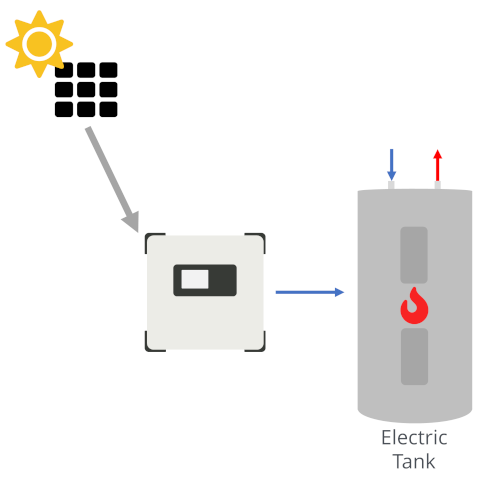

Slash your water heating overhead. By utilizing direct-harvest solar power, the SunHopper®-D reduces fossil fuel and grid energy requirements by 60-80% for a typical household installation.
Precision PV Hot Water Yield Estimator
Calculate your domestic hot water offset using irradiance data from the National Laboratory of the Rockies (NLR) v8 engine. Unlike traditional solar thermal systems that rely on complex plumbing, the SunHopper®-D uses standard PV panels to heat your water. Enter your zip code below to see your projected annual kWh harvest and grid-independence factor.
Disclaimer
Powered by the National Laboratory of the Rockies (NLR) v8 PVWatts engine with GreenPWR optimization models. High-efficiency PV hot water performance assumes optimal tilt and no shading. Reference model assuming electric storage UEF 0.92, Natural Gas 0.60, Propane 0.61.
Estimation Results
Solar Fraction
% of total load covered by PV
Savings Target
Efficiency vs. baseline
Energy Demand

Performance Summary
Enter your values and press 'Calculate' to see your potential solar hot water savings.
Why These Numbers Matter
Maintenance-Free
No pumps, no glycol, and no risk of freezing. Standard PV maintenance is all you need.
Winter Performance
PV-to-Thermal maintains efficiency in cold, clear winters compared to traditional vacuum tubes.
Scalability
Scale your array to meet your household hot water demand effortlessly as your needs grow.
How to Estimate Water Usage
Average shower: 20 gallons
Automatic dishwasher: 7 gallons
Clothes washing: 20 gallons
Reference: Energy.gov sizing guide. The average US household uses ~64 gal/day.

Engineering Behind the SunHopper®-D
Our algorithm utilizes weather data, usage over time, and geographic information. By optimizing the impedance matching between the DC PV string and the resistive heating element, the SunHopper®-D extracts maximum energy even during low-light conditions. This 'Direct-to-Tank' approach upgrades your storage hot water tank to an effective thermal battery.
By removing the efficiency losses associated with traditional solar thermal heat exchangers and the complexity of grid-tied electrical systems, we've created the most reliable path to carbon-reduced hot water.